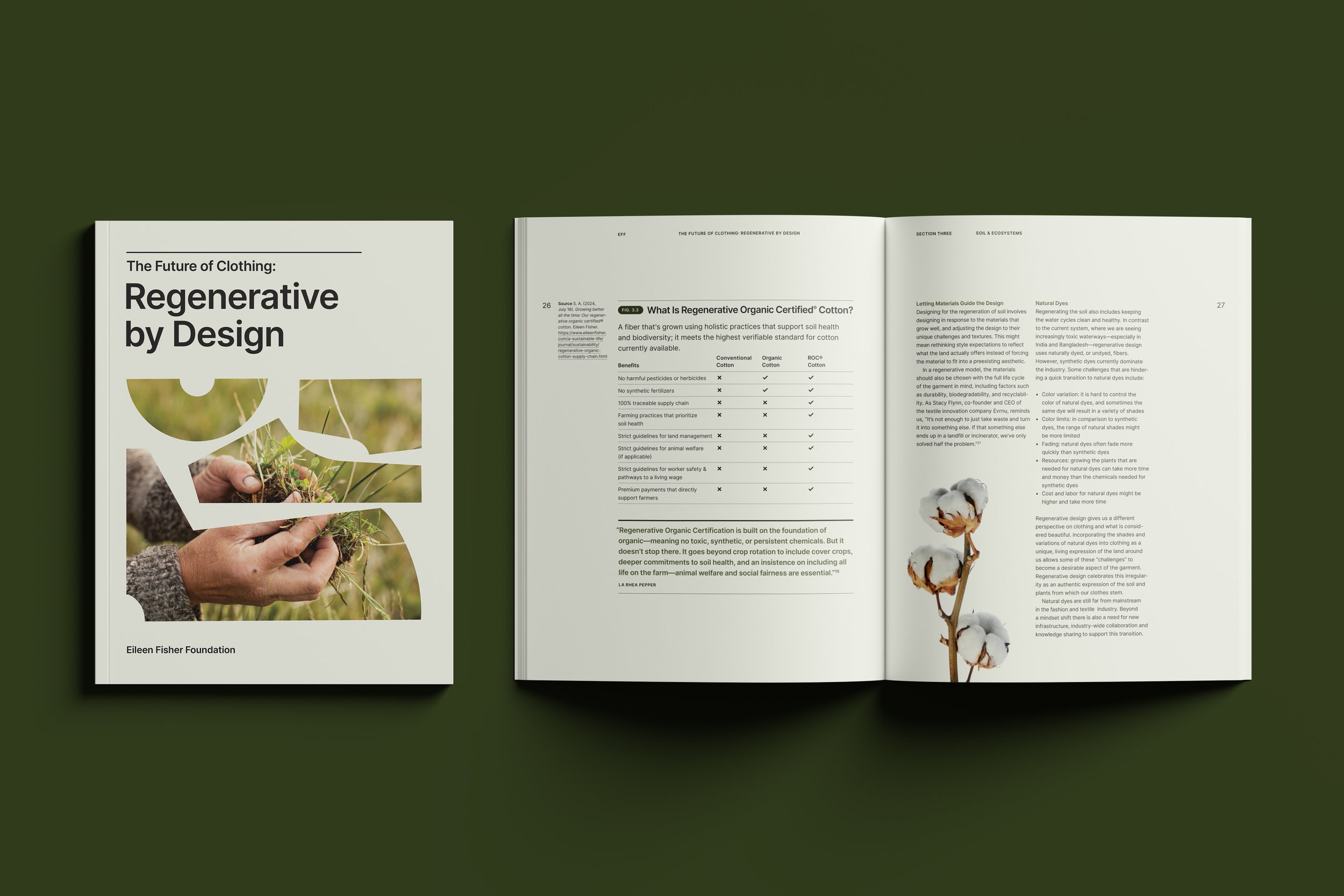

Designing for Regeneration
What Does Regenerative
Design Mean?
The concept of regenerative design in fashion crucially involves systems thinking, and the acknowledgment that we are always entwined with the living systems around us.
In this way, regenerative design shifts from viewing the design process as oriented exclusively toward the commodity to one that is focused on shaping relationships between people, products, and the planet.
The Current Dilemma
In 2023, the apparel sector's emissions increased by 7.5% from the previous year to 944 million tons²—an estimated 2% of global greenhouse gas emissions.³ In 2020, it was estimated that more than 70% of fashion’s greenhouse gas emissions come from raw material production, preparation, and processing.⁴ Polyester—notoriously derived from fossil fuels—accounted for 59% of global fiber production in 2024 and continues to be the most widely produced fiber in the world.⁵
The earth’s surface has lost enough moisture over the last four decades that it could affect both the spin of our planet and the location of our north pole.⁶ Each year, the fashion industry consumes an estimated 79 trillion liters of water.⁷ Textile production is also responsible for an estimated 20% of global clean water pollution—mostly due to the dyeing process.⁸
The garment and textile industry employs approximately 75 million people globally—1% of the world’s population—and 75% of that workforce are women.⁹ According to the The Industry We Want wage gap metric, garment workers in 2025 earned on average 41% less than they needed for an adequate standard of living.¹⁰
These negative impacts serve as a call to action: What change is possible if, instead of simply reducing this harm, clothing design becomes a medium for change and a source of positive ecological and social impact?

The Cost of Fashion
Environmental and social impact of the global fashion industry
2%
of global greenhouse gas emissions
70%
of fashion’s GHG emissions come from upstream activities like raw material production (2020)
59%
of global fiber production is polyester, derived from fossil fuels
20%
of global clean water pollution is due to textile production
79T
liters of water is consumed by the fashion industry per year
75M
garment & textile workers globally
75%
of that workforce are women
41%
wage gap vs. adequate standard of living (2025)
Envisioning a Regenerative Future of Clothing
For the fashion industry, holistic regeneration begins with design.
“Early stage design decisions determine 80% of the product's environmental impact.”¹
Ellen MacArthur Foundation, “An Introduction to Circular Design”
In “Framing Regenerative Fashion” (2024), Finnish scholars Aino Korhonen and Kirsi Niinimäki explore the discourse around regenerative fashion and distinguish two main approaches shaping the current fashion sector.¹¹ The quantitative approach treats fashion as a numbers-driven, market-focused method for achieving regeneration. The qualitative approach highlights deep inequalities in sustainable fashion and emphasizes a more nuanced and systemic way of addressing the issue. This analysis provides a foundation for the fashion industry to critically rethink prevailing narratives and begin shaping a more inclusive and forward-looking path. The shared core of the two approaches encapsulates key themes for reflection:
1) the current fashion system is failing; 2) the current narrative is lacking; 3) the industry must divest from fossil fuel fibers; and 4) soil can be a transformative factor in the shift toward change.¹¹
“The qualitative narrative is by no means a silver bullet or a coherent approach to regeneration by itself, but it could be argued that it offers a broader look at the systemic issues around fashion… [The qualitative] view sees regenerative agriculture practices as being less about measuring carbon capture and more about unlearning current industrial practices, relearning indigenous land stewardship and reconsidering current land rights.”¹¹
Annick Schramme and Nathalie Verboven, Sustainability and the Fashion Industry: Can Fashion Save the World?
Ways of Framing Regenerative Fashion
| Quantitative approach | Shared core | Qualitative approach |
|---|---|---|
| Fashion system is failing because of its impact on the environment | Fashion system is failing | Fashion system is failing because of its inability to sustain, heal and empower along its supply chains |
| Natural resources under threat | The insufficient sustainability narrative | Social justice under threat |
| Fashion system is fixed by low-carbon approaches, technological innovation, market-led approach | Fashion industry must divest from fossil fuel fibers | Fashion system is fixed by democratic processes and collective measures |
| Priorities: measured, certified approach to reducing the carbon footprint. Raw materials that increase carbon capture | Soil can work as a pivot point for systems change | Priorities: workers' rights, decentralisation, historical memory work, rethinking the distribution of wealth |
| New policy discourse needed to encourage technological innovation, e.g., regenerative startups | New policy discourse needed because structural change is required; corporations need stricter regulation | |
| Depoliticised discourse | Politicised discourse |
Environmental discourse classification table drafted according to Hajer’s division of discursive space for ecological modernisation (254:1995), Béné et al.’s narratives about food system failures (118:2019) and White et al.’s dimensions of environmental debate (85:2017)
Source Korhonen, A., & Niinimäki, K. (2024). Framing regenerative fashion. In A. Schramme & N. Verboven (Eds.), Sustainability and the fashion industry: Can fashion save the world? Routledge.
This study illuminates the shared need to shift the environmental and social impact of the fashion industry from degenerative to regenerative—an endeavor notably led by women at impactful organizations such as Slow Factory, Fibershed, Fashion Revolution, and Garment Worker Center.¹¹
The conversation is already happening, and there is a collective awareness of the need for systemic change. While there is not a set path or single solution, we can turn to the philosophy and practices behind regenerative agriculture as a guiding light to pave the way.